
Following on from my initial chat with Michelle and watching Colin’s first seminar, I’ve been sketching and thinking through different initial ideas.
One aim that will stretch me is working on collaborative portraits. I’ve not done too much portrait work in the past and it’s mainly been passive or secondary to the session rather than direct and engaged. I’ve contacted a few different people that I know to see if they will be up for it – one definitely is and there’s a few interested but unsure. For this initial first session, it’s an artist friend who I work with at my day job. She has also just completed an MA so is fairly familiar with what coursework aims I would have to hit.
Another line to follow is what I discussed with Michelle earlier about how to collaborate and represent people who don’t want to be photographed. This comes off the back of someone I talked to for the last Sustainable Strategies module with regards to Disability and Representation where their attitude towards themself on film has been dominated by their early experiences (and therefore don’t want to appear in photos). [see Photographs Not Taken edited by Will Steacy]
I listened to Kyle McDougall on The Contact Sheet podcast reviewing Alec Soth’s Magnum course and how Soth developed his methodology from From Here To There to Sleeping By The Mississippi. I want to look deeper into how he and other photographers develop that thread. I’ve previously looked at how Mark Power and Craig Mod have used geography to structure their projects, how can this apply to what I’d like to do.
Topic 1 discussion
Topic 1’s discussion picking “one image that responds to notions of collaboration and consent”. I picked a photo by Patrick Joust:
— start —
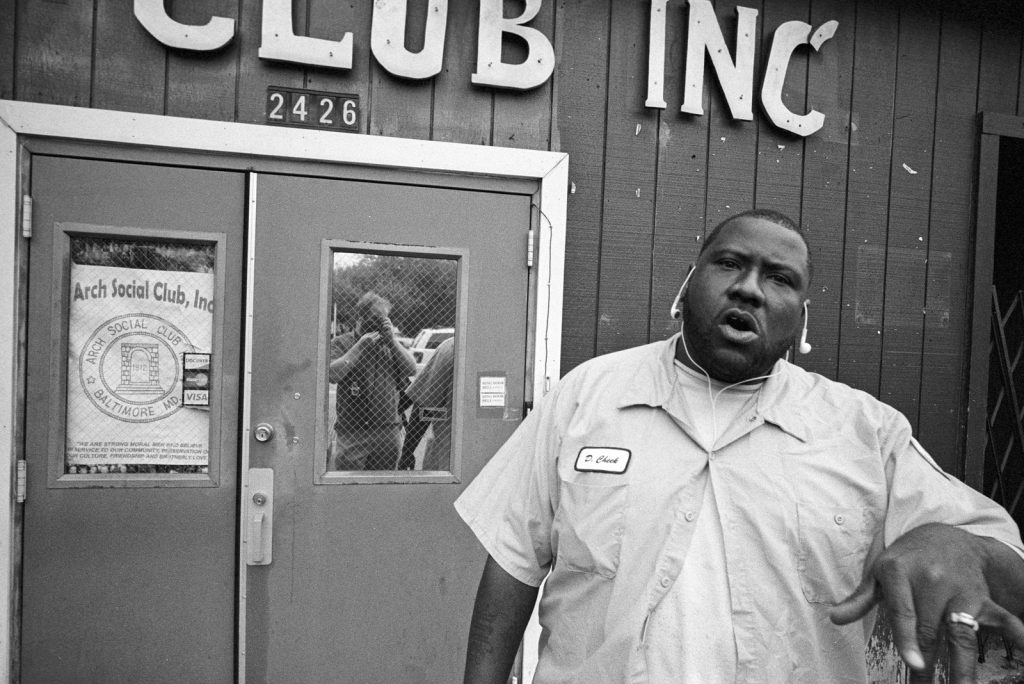
“He was actually very friendly. We had a nice little conversation and I snapped a couple of quick pictures, but he looked kind of angry in both of them. We were talking about how it was too bad that the Cadillac Parade on Pennsylvania Avenue wasn’t happening this year.”
Patrick Joust is a portrait and night-time photographer primarily shooting in Baltimore and Pennsylvania. He’s a hobbyist photographer with a day job who has become fairly noted for his work and the easy availability of his archive (there’s an enormous amount of his photos up on Flickr).
This photo is one of thousands that he’s taken whilst walking around the city chatting to people. As a collaboration, it’s pretty low level in terms of some of the other examples that have been posted. There is an established relationship (however brief) with a touch of performance and what could be interpreted as a defensive posture. But you can see from the photographer’s reflection in the window that they’re both fairly comfortable and quite casual with each other. It’s not just passive street photography, it’s much more equitable and thoughtful.
In an interview with the Contact Sheet podcast, Joust describes making portraits for him as “a true collaboration”. For this photo I think that given the time taken and the power balance still leaning towards him as the photographer I don’t think that it’s totally true but this shows how subjective the idea of collaboration can be – what’s a true collaboration for him and his situation might not be for others.
References:
Figure 1. Patrick JOUST. 2012. Untitled. Flickr [online]. Available at https://www.flickr.com/photos/patrickjoust/8114392821/in/album-72157611470203647/ [accessed 22 September 2022]
MCDOUGALL, Kyle [Presenter]. 2020. The Contact Sheet: Patrick Joust – A Love For The Craft. Available at https://the-contact-sheet.sounder.fm/episode/patrick-joust?page=2
KALLIANIOTIS, Niko J. 2017. Interview: Patrick Joust. Available at https://www.nikokallianiotis.com/blog-1/2017/7/30/an-interview-with-patrick-joust [accessed 22 September 2022]
— finish —
Questions that came up after further reading and analysis:
- Are Joust’s photos part of Martha Rosler’s ‘liberal social conscience’ that Ashley la Grange talks about? Do I see myself in Joust’s approach and work through the work I’ve done with a disability charity?
- Does a collaborative work deteriorate over time and the collaboration become uneven due to a photographers use? [see Lucy Lippard’s Doubletake: The Diary of a Relationship With An Image] Rosler also talks about documentary photographs have two moments: ‘(1) the “immediate,” instrumental one… arguing for or against a social practice and its ideological-theoretical supports, and (2) the conventional “aesthetic-historical” moment…in which the viewer’s argumentiveness cedes to the…pleasure afforded by the aesthetic “tightness”… of the image’ (p.317).’ (cited in la Grange 2005:117)
Others looked at:
- As It May Be by Bieke Depoorter – this work is a transformative collaboration by starting out as an initial photo then moves on to something new by people writing on it and creating debate about modern Egypt
- Unseen UK by UK postmen and women
- Nigel Shafran – RuthBook
To do
- Continue to solidify aims for this module – what I’d like to do, what am I saying, what am I passionate about, what’s my subject matter and what will stretch me?
- Next webinar with Colin
- Still to work through Multistory site and take notes on it
- Following up more emails and messages about portrait projects
Upcoming
- Initial portrait photoshoot with subject (weekend of 1st-2nd October 22)
Reading
LIPPARD, Lucy R. 1991. ‘Doubletake: The diary of a relationship with an image’. Third Text, 5(16-17), 135-144.
ROSE, Gillian. 2016. Visual Methodologies : an Introduction to Researching with Visual Materials. 4th edition. Los Angeles: SAGE.
LA GRANGE, Ashley. 2005. Basic Critical Theory for Photographers. Oxford: Focal.
DYER, Geoff. 2021. See/saw Looking at Photographs : Essays 2010-2020. Edinburgh: Canongate Books.
ROSLER, Martha. 1992. ‘In, around and afterthoughts (on documentary photography)’. BOLTON, Richard (ed.). Contest of Meaning: Critical Histories of Photography. Cambridge, Mass: MIT Press 1989. [page no’s need confirming]
KUIT, Lynda. 2015. Martha Rosler: In, around, and afterthoughts (on documentary photography) [online]. Available at: https://lyndakuitphotographycn.wordpress.com/2015/05/18/martha-rosler-in-around-and-afterthoughts-on-documentary-photography/ [accessed 26 September 22]
WOLF, Sasha. 2019. Photowork : Forty Photographers on Process and Practice. First edition. Edited by Sasha Wolf. New York, NY: Aperture.
FULFORD, Jason and Greg HALPERN. 2014. The Photographer’s Playbook : 307 Assignments and Ideas. First edition. Edited by Jason Fulford and Greg Halpern. New York: Aperture.
STEACY, Will. 2012. Photographs Not Taken: a Collection of Photographers’ Essays. Daylight.
POLIS. 2011. Susan Sontag on the Photographer as Flâneur. Available at https://www.thepolisblog.org/2011/06/featured-quote-susan-sontag-on.html [accessed 26 September 22]